

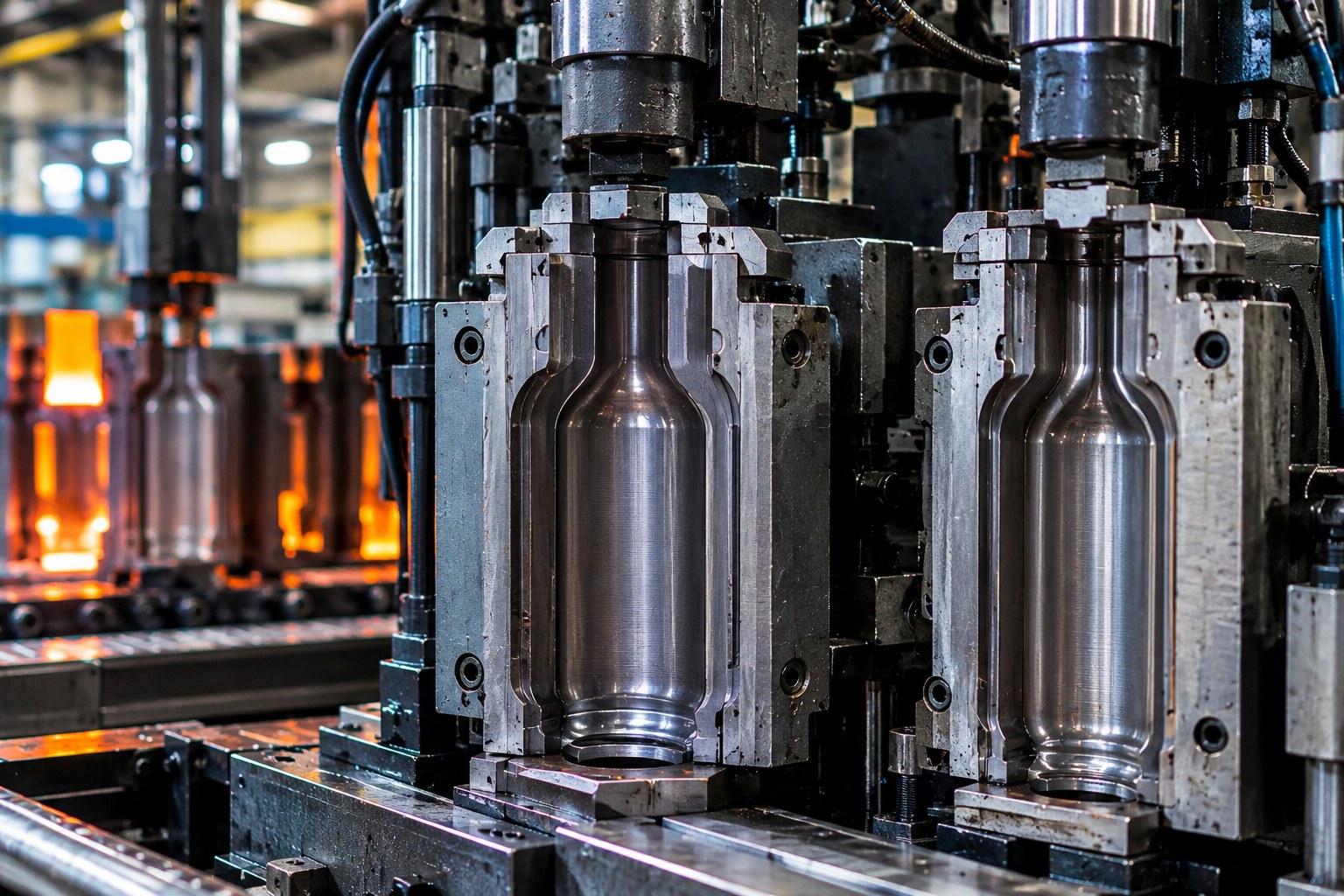
A custom glass bottle starts long before molten glass enters a production machine. For brands developing a distinctive spirits bottle or premium packaging format, one of the most important steps is creating the glass bottle mold that gives the finished bottle its shape, dimensions, details, and overall appearance.
A bottle mold is a precision tool designed specifically for the glass-forming process. It must withstand extremely high temperatures, repeated production cycles, and the mechanical forces involved in forming thousands of bottles.
For businesses ordering custom glass bottles, understanding how molds are made can make it easier to plan a project, control costs, evaluate bottle designs, and establish realistic production timelines.
This guide explains how custom glass bottle molds are designed and made, what affects mold cost, how mold design influences bottle quality, and what brands should know before moving into mass production.
What Is a Glass Bottle Mold?
A glass bottle mold is a specially engineered metal tool used to form molten glass into a specific bottle shape.
During production, a measured amount of molten glass, called a gob, is transferred into the forming equipment. The mold provides the cavity into which the glass is shaped. Air pressure and mechanical forming processes help force the hot glass against the internal surfaces of the mold.
Once formed and cooled through the annealing process, the glass retains the shape created by the mold.
For a standard bottle, a supplier can use an existing mold or established bottle design. For a completely new bottle, however, a custom mold must generally be engineered and made.
The mold determines important characteristics such as:
- Bottle height and diameter
- Shoulder shape
- Base design
- Body contours
- Neck and finish dimensions
- Embossed details
- Recesses and other surface features
- Overall bottle weight and glass distribution
This makes the mold one of the most important pieces of tooling in custom glass bottle production.
Why Are Custom Glass Bottle Molds Necessary?
A custom mold is necessary when a brand wants a bottle shape that cannot be produced using an existing standard mold. For example, a spirits company may want:
- A distinctive bottle silhouette
- A wide or unusually shaped shoulder
- A heavy premium base
- Custom embossing
- A sculpted bottle body
- A proprietary neck design
- A bottle designed specifically around its brand identity
Instead of adapting an existing bottle, the supplier creates tooling based on the approved bottle design. This gives brands much greater control over the final product.
For premium spirits and liquor packaging, that control can be particularly important because the bottle itself often plays a major role in the product’s visual identity. Our article on how bottle shape affects brand perception explores this in more depth.
How Are Glass Bottle Molds Made?
Although the exact process varies according to the supplier, bottle tooling generally follows several key stages.
1. Bottle Design and Engineering
The mold-making process begins with an approved bottle design. The design may originate from:
- A brand’s existing CAD files
- A packaging designer
- A 3D model
- Technical drawings
- A physical prototype
- A concept developed with the glass supplier
At this stage, the design needs to be translated into a bottle that can be produced in glass. A visually attractive design is not automatically suitable for glass production. Engineers need to consider how molten glass will flow, how the bottle will be formed, how glass thickness will be distributed, and how the bottle will release from the mold.
Important engineering considerations include:
- Overall dimensions
- Glass distribution
- Bottle weight
- Wall thickness
- Neck finish
- Base geometry
- Draft and mold-release requirements
- Embossed or recessed details
- Tolerances
- Compatibility with production equipment
This stage is critical because problems discovered after production tooling has been made can increase both cost and lead time. For a look at the design errors that most often cause trouble, read 10 Mistakes to Avoid When Designing a Liquor Bottle.
2. Creating the Mold Design
Once the bottle design has been technically approved, the supplier creates the corresponding mold design. The mold is essentially the negative form of the bottle.
If the finished bottle has a raised logo, for example, the corresponding mold cavity must contain the geometry required to create that feature in the glass. Likewise, curved shoulders, recessed panels, decorative grooves, and other bottle details need to be incorporated into the mold.
Modern production typically uses digital engineering and CAD/CAM processes to develop this tooling accurately. The mold design must account for the fact that the bottle is formed from extremely hot glass and that the finished dimensions need to remain within the required tolerances after forming and cooling.
3. Selecting the Mold Material
Glass bottle molds must survive repeated exposure to molten glass and high operating temperatures. For this reason, mold components are made from specialized materials selected for:
- Heat resistance
- Wear resistance
- Dimensional stability
- Thermal performance
- Durability
- Machinability
The specific material and tooling construction depend on the bottle design, production equipment, expected production volume, and other requirements. The goal is to create a mold that can repeatedly produce bottles with consistent dimensions and appearance.
4. Machining the Mold
After the mold design is finalized, the mold components are made using precision machining processes. Computer-controlled machining equipment can produce the detailed cavity required to form the bottle. The machining process may include:
- Preparing the mold material
- Rough machining the main geometry
- Precision machining the bottle cavity
- Creating detailed features
- Machining neck and base areas
- Finishing critical surfaces
- Checking dimensions against the engineering specifications
The greater the complexity of the bottle, the more demanding the tooling process can become. A simple cylindrical bottle may require relatively straightforward tooling. A highly sculpted spirits bottle with complex curves, deep embossing, unusual geometry, or intricate detailing can require considerably more engineering and machining.
5. Creating Bottle Details in the Mold
One of the major advantages of custom molds is the ability to incorporate branding directly into the glass. A bottle can potentially include details such as:
- Embossed logos
- Recessed logos
- Text
- Decorative patterns
- Geometric textures
- Custom base designs
- Raised symbols
- Brand-specific shapes
These details need to be carefully engineered because very fine or complicated features may affect how the glass fills the mold. For example, a logo that looks excellent in a digital rendering may need to be simplified or adjusted to produce a clear and consistent result in production.
This is why collaboration between the bottle designer and the glass supplier is important before tooling begins.
6. Mold Finishing and Inspection
After machining, mold components need to be finished and inspected. The surfaces that contact the glass are particularly important because imperfections in the mold can potentially appear on the finished bottle. Suppliers may inspect the tooling for:
- Dimensional accuracy
- Surface quality
- Correct cavity geometry
- Alignment
- Detail definition
- Neck and finish dimensions
- Base geometry
- Overall tooling integrity
Precision at this stage helps establish the consistency required for mass production.
7. Testing the Mold
A new custom mold is not simply made and immediately assumed to be perfect. It needs to be tested through the bottle production process. Trial production allows the supplier to evaluate how the glass behaves inside the new tooling and whether the resulting bottles meet the approved specifications. Testing can reveal issues involving:
- Glass distribution
- Bottle dimensions
- Weight
- Surface appearance
- Detail definition
- Mold alignment
- Neck finish
- Base stability
- Overall bottle quality
If adjustments are required, the tooling or bottle design may need to be refined before mass production begins. This testing stage is one reason why custom bottle projects require more time than selecting an existing standard bottle.
How Long Does It Take to Make a Custom Bottle Mold?
The mold is only one part of a larger custom bottle project. For a new custom bottle, a typical production sequence can include:
| Stage | Typical timeframe |
|---|---|
| Sampling | Approximately 6 weeks |
| Production molds | Approximately 5 weeks |
| Mass production | Approximately 6–8 weeks |
| Total production stages | Approximately 17–19 weeks |
These timeframes represent production stages and do not include shipping or other project-specific stages. The actual schedule can vary depending on the complexity of the bottle, design approval process, sampling requirements, tooling specifications, production planning, and other project factors. For this reason, brands should begin bottle development well before the desired product launch date.
For a full stage-by-stage breakdown, see How Long Does It Take to Manufacture Custom Glass Bottles?
How Much Does a Custom Bottle Mold Cost?
The cost of a custom glass bottle mold depends on the complexity of the bottle and the tooling requirements. Factors that can influence mold costs include:
Bottle shape
A simple bottle shape is generally less demanding to tool than a highly sculpted or unconventional design.
Bottle details
Embossing, recessed elements, textures, unusual contours, and other decorative features can increase tooling complexity.
Number of tooling components
The construction of the mold and the number of components required can vary according to the bottle and production process.
Engineering requirements
More complicated bottle designs can require additional engineering, testing, and refinement.
Production quantity
The economics of custom tooling are closely connected to production volume. A custom mold represents an upfront investment, which is why larger production runs can make custom packaging more commercially practical.
For brands planning approximately 20,000 bottles or more, it is useful to consider tooling as part of the overall packaging investment rather than looking at the mold as an isolated expense. Our guide to how much a custom glass bottle costs covers the wider cost picture.
Does the Mold Determine Bottle Quality?
The mold is an important contributor to bottle quality, but it is not the only factor. Finished bottle quality also depends on:
- Glass composition
- Glass clarity
- Bottle weight
- Glass distribution
- Melting and forming conditions
- Annealing
- Mold condition
- Production equipment
- Inspection procedures
- Decoration processes
- Packaging and handling
For premium spirits packaging, glass quality can be particularly important. Fusion Glassworks works with several glass-quality categories, including standard flint, super flint, and extra flint. Standard flint can be suitable for many applications, while super flint and extra flint are appropriate for premium spirits where a high level of glass clarity is important.
How Bottle Weight Affects Mold Design
Bottle weight is another consideration during mold development. A heavier bottle may be part of a premium packaging strategy, particularly for spirits brands seeking a substantial feel in the hand. However, adding glass affects more than the bottle’s perceived weight. It can influence:
- Material usage
- Production economics
- Shipping weight
- Glass distribution
- Bottle dimensions
- Production requirements
- Overall packaging cost
Mold Design and Bottle Decoration Are Different
A common misconception is that every visual feature on a premium bottle needs to be incorporated into the glass mold. That is not necessarily the case. Brands can combine custom bottle geometry with separate decoration processes. Depending on the project, decoration may include:
- Printed labels
- Ceramic heat transfer
- Acid etching or frosting
- Food-safe spray coating
- Glass coloration
This gives brands additional ways to create a premium appearance without requiring every visual element to be physically molded into the glass. Decoration can also have a significant impact on total bottle cost. For highly complex decoration, the decoration process can sometimes cost more than the bottle itself. Therefore, bottle tooling and decoration should be considered separately when developing a packaging budget. Learn more about our bottle decoration services.
Can a Custom Mold Be Used for Different Bottle Sizes?
It depends on the design. A mold is engineered for a specific bottle configuration and cannot simply be assumed to work for every capacity. For example, a 750ml bottle and a 1-liter bottle may have different:
- Heights
- Diameters
- Glass weights
- Shoulder proportions
- Base dimensions
- Internal volumes
- Glass-distribution requirements
If a brand wants several bottle sizes within the same design family, each size should be evaluated during the engineering stage. The supplier can then determine the appropriate tooling requirements for each format.
What Should Brands Consider Before Making a Custom Mold?
Before approving a custom bottle mold, brands should make several decisions.
Define the bottle’s purpose
Determine whether the bottle is intended for spirits, liquor, wine, liqueurs, premium food products, or other beverages. The product category can influence the bottle’s shape, finish, weight, closure, and packaging requirements.
Finalize the bottle design
Avoid rushing into tooling while major design decisions are still changing. Changes after tooling begins can create additional costs and delays.
Choose the glass quality
Decide whether standard flint, super flint, or extra flint is appropriate for the desired appearance. For premium spirits, greater clarity can be an important part of the packaging strategy.
Determine the bottle weight
A heavier bottle can create a substantial premium feel, but it also increases material usage and logistics weight.
Select the closure
The bottle neck and finish need to be compatible with the selected closure. Possible closure options include:
- ROPP/Stelvin closures
- Plastic screw caps
- Cork
The closure should be considered during bottle engineering rather than added as an afterthought. See our overview of bottle closures for the available options.
Plan decoration early
If the bottle will use frosting, coatings, ceramic transfer, coloration, labels, or other decorative techniques, these requirements should be considered during the packaging-development process.
Custom Bottle Mold vs. Standard Bottle Mold
The decision between a standard bottle and a custom bottle often comes down to brand requirements, quantity, budget, and timing.
| Consideration | Standard Bottle | Custom Bottle |
|---|---|---|
| Bottle design | Existing design | Brand-specific design |
| Custom shape | Limited | Extensive |
| Custom embossing | Limited | Possible |
| Mold development | Usually not required | Required |
| Upfront tooling | Lower | Higher |
| Design flexibility | Lower | Higher |
| Development timeline | Generally shorter | Longer |
| Brand differentiation | More limited | Greater design control |
For a brand launching a premium spirits product, a custom bottle can provide significantly more control over the physical packaging. However, the additional design freedom comes with additional engineering, tooling, testing, and lead-time requirements.
How Custom Bottle Molds Fit Into the Production Process
A custom mold is one stage within the broader glass bottle production process. For a step-by-step look at the rest of that process, read our guide to the glass bottle manufacturing process. The overall process typically involves:
- Bottle concept and design
- Technical engineering
- Sampling
- Mold development
- Mold testing and approval
- Glass preparation
- Melting
- Gob formation
- Bottle forming
- Annealing
- Quality inspection
- Decoration, if required
- Packaging
- Shipment
The mold connects the design stage to physical bottle production. Once approved, it allows the glass supplier to reproduce the bottle design consistently across a production run.
How Many Bottles Should You Order for a Custom Mold?
Custom tooling is generally more practical when spread across a meaningful production volume. Fusion Glassworks has a minimum order quantity of 20,000 bottles. For brands planning a custom spirits bottle, this quantity should be considered when calculating the total packaging investment.
The cost per bottle can depend significantly on production quantity, glass quality, bottle weight, decoration, and design complexity. A larger production quantity can help distribute fixed development and tooling costs across more units, although the exact economics depend on the project.
What Happens After the Mold Is Approved?
Once the custom mold and bottle samples are approved, the project can move into mass production. During production, molten glass is formed using the approved tooling. The bottles then pass through annealing, inspection, and any required decoration and packaging processes. Quality control helps verify that bottles remain within the agreed specifications throughout production.
For brands, the goal is not simply to create one attractive prototype. The tooling must allow the supplier to produce large quantities of bottles with consistent appearance and dimensions.
Choosing a Supplier for Custom Glass Bottle Molds
The mold maker and glass bottle supplier are important partners in a custom packaging project. When evaluating a supplier, consider whether they can support:
- Custom bottle design
- Technical engineering
- Custom mold development
- Bottle sampling
- Mass production
- Glass-quality selection
- Bottle coloration
- Decoration
- Closures
- Packaging
- Production quality control
It is also useful to ask how the supplier handles design revisions, mold testing, sampling, quality control, and production scheduling. A supplier that can support multiple stages of the process can make communication and project coordination easier.
Frequently Asked Questions About Glass Bottle Molds
What is a glass bottle mold?
A glass bottle mold is a precision tool used to shape molten glass into a specific bottle design. It creates the bottle’s external geometry, including its body, shoulders, base, and other molded details.
How is a custom glass bottle mold made?
A custom mold typically starts with an engineered bottle design. The corresponding mold cavity is then digitally designed, made from suitable tooling materials, precision machined, finished, inspected, and tested during bottle production.
How long does it take to make a custom bottle mold?
For a new custom bottle project, production molds can take approximately 5 weeks according to the typical Fusion Glassworks production schedule. The complete process, including sampling and mass production, is approximately 17–19 weeks, excluding shipping and other project-specific stages.
Can a logo be included in a bottle mold?
Yes. Depending on the design, logos and other branding elements can be incorporated into the bottle through embossed or recessed glass details. The artwork must be engineered appropriately for reliable production.
Are custom bottle molds expensive?
Custom molds create an additional tooling investment compared with using an existing standard bottle. The cost depends on bottle geometry, complexity, tooling requirements, and other project-specific factors.
Can a custom mold be reused?
Custom molds are designed for repeated bottle production, subject to the tooling design, production conditions, maintenance, and expected service life.
What glass quality is best for premium spirits?
Premium spirits often benefit from higher-clarity glass when visual presentation is important. Fusion Glassworks offers standard flint, super flint, and extra flint options, with super flint and extra flint suited to applications where enhanced clarity is desired.
What is the minimum order for custom bottles?
Fusion Glassworks has a minimum order quantity of 20,000 bottles.
Can I customize the bottle and the decoration?
Yes. A custom bottle can be combined with different decoration options, including printed labels, ceramic heat transfer, acid etching or frosting, food-safe spray coating, and glass coloration. Decoration costs vary substantially depending on the complexity of the finish.
Build a Custom Glass Bottle With the Right Mold
A custom glass bottle mold is the foundation for turning a packaging concept into a repeatable production bottle. The process involves much more than machining a cavity. The bottle needs to be engineered for glass production, the tooling needs to reproduce the design accurately, and samples need to be evaluated before mass production begins.
For spirits and premium packaging, these decisions can affect everything from bottle appearance and weight to glass clarity, decoration, closures, production costs, and lead time.
Fusion Glassworks supports brands through the custom glass bottle process, including custom bottles, custom molds, standard bottles, colored glass, decoration, closures, and packaging. With a minimum order quantity of 20,000 bottles, brands can work with a supplier to develop packaging around their product, design, and production requirements.
Ready to develop a custom spirits bottle? Contact Fusion Glassworks to discuss your bottle design, mold requirements, glass quality, decoration, quantity, and production timeline.